close
Choose Your Site
Global
Social Media
Views: 0 Author: Site Editor Publish Time: 2026-09-23 Origin: Site
Sourcing a drive component is a high-stakes engineering decision. Selecting the wrong supplier can result in catastrophic product failures, costly recalls, and disrupted production timelines. The global market is saturated with thousands of suppliers ranging from premium tier-one manufacturers to white-label distributors. This saturation makes it difficult to verify actual production capabilities, quality control standards, and long-term financial stability.
To mitigate supply chain and engineering risks, procurement and design teams must utilize a strict, evidence-based framework. You need to vet potential partners based on technical alignment, testing rigor, and scalability. Relying on marketing brochures is no longer sufficient for modern manufacturing demands. You must dig into the engineering data, audit the facility's testing capabilities, and ensure their production lifecycle matches your project requirements from prototype to mass assembly.
Define technical parameters first: A reliable supplier cannot be identified without strict baseline requirements for torque, speed, operating environment, and form factor.
Verify testing and QA infrastructure: Trustworthy manufacturers maintain in-house dynamometer testing, environmental stress screening, and verifiable ISO certifications.
Assess scalability and MOQs: The right partner must align with your production lifecycle, offering feasible Minimum Order Quantities (MOQs) for prototyping through mass production.
Evaluate Total Cost of Ownership (TCO): Upfront unit cost is secondary to the long-term costs associated with motor lifespan, maintenance, and failure rates.
Approaching a manufacturer without a finalized specification sheet leads to mismatched capabilities and wasted time. You must define your success criteria clearly. Without strict parameters, suppliers will quote standard catalog items that may fail under your specific load conditions. Engineering teams must lock down the mechanical and electrical constraints before initiating contact with any vendor.
Determine your physical constraints early in the design phase. You must account for NEMA frame sizes, shaft dimensions, and mounting configurations. Sourcing replacements for proprietary OEM form factors presents a unique engineering challenge compared to standard catalog sizes. OEM motors often feature custom mounting pitches or non-standard shaft lengths that require specialized tooling to replicate.
Reverse-engineering legacy motors is necessary when documentation is missing. Extract critical electrical and mechanical specifications carefully. Follow these steps to ensure accurate replication:
Measure the physical dimensions with digital calipers to ensure a drop-in replacement fits your existing housing. Record the outer diameter, body length, and shaft diameter.
Map the mounting hole pitch and thread size. This dictates how the motor secures to the gearbox or chassis.
Use a dynamometer to map the torque-speed curve accurately. Record the stall torque and no-load speed.
Measure the voltage and current draw under typical load conditions using a bench power supply and multimeter.
Inspect the shaft for custom modifications like flats, keyways, or cross-holes.
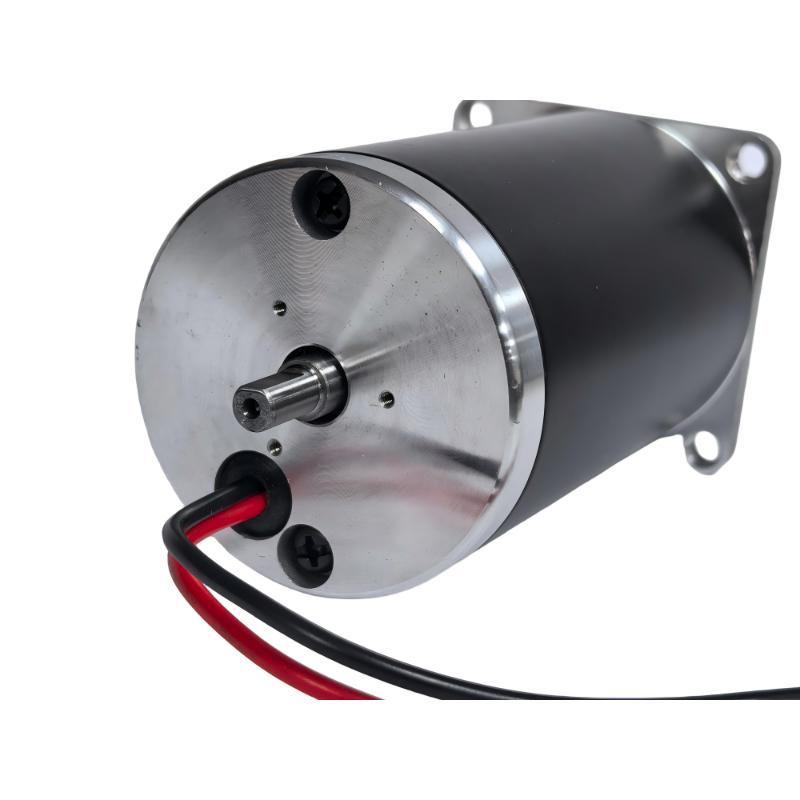
Match the motor topology directly to your application requirements. A 24V brushed DC motor is ideal for cost-sensitive projects. It works well with simple control systems, intermittent duty cycles, and traditional appliance drives. The brush commutation provides straightforward speed control without complex electronics. We often specify these for applications where continuous operation is not required, allowing the brushes to cool between cycles.
Contrast this with the requirements for a 48V brushless DC motor. These units excel in continuous duty and high-efficiency applications. They require complex electronic commutation but dominate in industrial automation and motion simulators. The lack of physical brushes eliminates a primary wear point, drastically extending operational life. You will need to integrate a compatible electronic speed controller (ESC) to manage the phase switching.
Spatial and weight considerations dictate the integration of a high-density mini DC motor. Compact consumer electronics, handheld tools, and medical devices require massive power in tight envelopes. Evaluate the DC Motor as an integrated system. Consider motor-gearbox mating, choosing between planetary or spur gearheads based on torque requirements. Match the motor with appropriate electronic speed controllers or servo drives for optimal system performance.
Motor Topology | Typical Voltage | Best Application Use Cases | Control Complexity |
|---|---|---|---|
Brushed | 12V - 24V | Intermittent duty, cost-sensitive consumer goods | Low (Direct DC or simple PWM) |
Brushless (BLDC) | 24V - 48V+ | Continuous duty, industrial automation, robotics | High (Requires ESC/Servo Drive) |
Coreless / Mini | 3V - 12V | Medical devices, precision handheld tools | Medium (Depends on feedback loop) |
Reliability extends beyond the physical product. It encompasses the manufacturer's operational maturity, quality control processes, and supply chain resilience. You must audit their facility capabilities and verify their claims through independent certification bodies.
Mandatory baseline certifications prove a manufacturer's commitment to quality. Look for ISO 9001 for general manufacturing. Medical applications require ISO 13485. Automotive integration demands IATF 16949, while aerospace projects need AS9100. Furthermore, ensure RoHS, REACH, CE, and UL compliance for global market distribution. These certifications prevent customs rejections and ensure environmental compliance.
ISO 9001: Baseline quality management system.
ISO 13485: Medical device manufacturing standards.
IATF 16949: Automotive sector quality management.
AS9100: Aerospace and defense specifications.
Reliance on third-party testing is a red flag for tier-one suppliers. A reliable manufacturer must possess comprehensive in-house testing equipment. Critical methods include thermal mapping, vibration analysis, and EMI/RFI emission testing. They must validate IP ratings for water and dust ingress internally. Accelerated life testing (ALT) is non-negotiable for predicting long-term reliability under stress. If they cannot provide raw data from their own dynamometers, look elsewhere.
Evaluate the manufacturer's control over their own raw materials. Sourcing rare-earth magnets, copper windings, and high-grade bearings internally reduces risk. Vertically integrated manufacturers offer better protection against global supply chain shocks. They experience less lead-time volatility because they do not rely heavily on external sub-contractors for critical sub-assemblies like commutators or stators.
Understand the value proposition of premium, ultra-high-precision manufacturers for mission-critical systems. Tier-1 global brands dominate medical, military, and aerospace sectors. Weigh the cost-to-benefit ratios of different manufacturing hubs. North America offers local engineering support and domestic defense compliance. Europe provides high precision and stringent environmental standards. Asia delivers massive scalability, cost efficiency, and deep component supply chains.
Deciding between custom engineering and standard catalog items impacts your project timeline and budget significantly. You must weigh the immediate availability of standard units against the optimized performance of bespoke designs.
Commercial Off-The-Shelf (COTS) solutions offer immediate availability. They require lower upfront engineering effort and provide proven reliability data. Standard configurations often meet 90% of application needs. Use COTS motors for rapid prototyping or when your design envelope is flexible enough to accommodate standard NEMA frame sizes. This approach drastically reduces time-to-market for new product introductions.
Working with a manufacturer for custom modifications requires clear communication. You may need custom shaft lengths, specific gear ratios, or specialized lead wires. Connector termination must match your existing wiring harness. Motion control feedback integration is critical for robotics. Source motors with integrated optical or magnetic encoders for closed-loop position and velocity feedback. Be prepared for engineering overhead, tooling fees, and Non-Recurring Engineering (NRE) costs associated with bespoke designs.
Modification Type | Engineering Effort | Typical NRE Cost Impact |
|---|---|---|
Custom Shaft Length/Flats | Low | Minimal |
Custom Winding (Voltage/Speed) | Medium | Moderate |
Integrated Encoder/Feedback | High | Significant |
Custom Gearbox Ratio | High | Significant (Tooling required) |
Evaluating a supplier requires looking past the initial unit quote. Long-term operational reliability determines the true value of your sourcing decision. You must analyze the materials used in the motor's construction to predict its failure rate in the field.
Cheaper initial unit costs often correlate with inferior brush materials. Low-grade bearings and lower-grade neodymium magnets lead to premature thermal degradation. This degradation results in early field failures. Factor in warranty claims, field replacement labor, and brand reputation damage when assessing the true value of a motor supplier. A motor that costs ten percent less upfront but fails twice as fast will destroy your project budget.
Analyze how manufacturers structure their production tiers. Finding a supplier willing to support low-volume prototyping runs is crucial. They must use identical production-line materials for these prototypes. Do not commit to high-volume production until the prototype passes all internal bench tests and field trials. Negotiate prototype batches of 10 to 50 units before signing a contract for thousands.
Transitioning from prototype to mass production introduces significant supply chain risks that must be managed proactively. You cannot assume the production units will perfectly match the hand-built prototypes without strict oversight.
Beware of bait and switch tactics. Approved prototype materials are sometimes quietly replaced with cheaper alternatives in mass production. To mitigate this risk, require strict Bill of Materials (BOM) lock agreements. Demand material certificate checks for every batch. Conduct unannounced facility audits to verify compliance. Inspect the incoming shipments to ensure the bearing brands and wire gauges match the approved engineering drawings.
Language barriers and time zone delays can derail critical engineering projects. Lack of direct access to the manufacturer's design engineers slows down troubleshooting. Establish clear Service Level Agreements (SLAs) for communication response times. Require a dedicated technical account manager who understands your specific application requirements and can translate your engineering needs to the factory floor.
Finding a reliable supplier requires moving beyond marketing claims. You must conduct rigorous technical, financial, and operational due diligence. Narrow down your initial list of suppliers through a structured Request for Information (RFI) and Request for Quote (RFQ) process. Aim for a shortlist of three highly qualified candidates.
Finalize your technical specification sheet with exact torque, speed, and voltage requirements.
Request initial COTS samples for internal bench testing and thermal validation.
Schedule virtual or physical audits of the shortlisted manufacturing facilities.
Secure a locked Bill of Materials (BOM) agreement before placing the first production order.
A: Request their ISO certification registration numbers for independent verification. Ask for sample First Article Inspection Reports (FAIR). Audit their in-house testing equipment like dynamometers and environmental chambers to ensure they do not outsource critical quality checks.
A: MOQs vary heavily by manufacturer. Standard catalog motors may have no MOQ. Custom-wound or modified motors typically require MOQs ranging from 500 to 5,000 units, depending on the tooling and raw materials required.
A: Measure the outer diameter, length, shaft size, mounting holes, and electrical parameters. Consult global manufacturer catalogs for a form-fit-function equivalent, as OEMs rarely sell direct replacements to end-users.
A: Sourcing brushed motors focuses heavily on brush material lifespan and commutator quality. Sourcing brushless motors requires evaluating the electronic commutation components, sensor reliability, and thermal management of the stator windings.
A: In-house testing ensures the manufacturer has direct control over quality validation. It allows for rapid iteration during prototyping and guarantees that production units are tested against your exact load and environmental specifications before shipping.